9 October 2016

Intro to Autodesk Maya: Texturing Part 1 - Common Shaders

Base
Ceramic
Chrome
Glass
Glow with object
Glow without object
Gold
Plastic
Silver

8 October 2016

The 12 Principles of Animation

The 12 Principles of Animation 

These principles were developed at Disney and made famous by Ollie Johnston and Frank Thomas. They are very useful to keep in mind when animating and, although developed for 2D animation, are still useful in stop motion and digital 3D animation. 

Fig. 1 Johnston and Thomas depicted in 'The Incredibles' (2004)

Squash and Stretch - Objects need to appear flexible and lively to catch interest and seem believable, using squash and stretch can show this flexibility. In animation, it's quite useful to exaggerate with squash and stretch to really get a sense of dynamic action. 

Anticipation - Using anticipation can ensure that the audience is looking in the right place on the screen before an action takes place. Things often happen quickly and if something happens out of nowhere it might be missed or context lost. Having something move slightly back before it moves forward is an example of this and it can make actions more believable. The amount of anticipation used can be varied depending on how dramatic the movement is going to be and on a variety of other factors, too. 

Staging - The set up of a scene can have a massive impact on how the audience thinks and feels when they view it. Camera angles and compositions can be used to make sure that facial expressions are clear and that the correct mood is conveyed. Lighting, camera movement and figure placement are all important tools for setting a scene. 

Straight ahead and pose to pose animation - In Straight Ahead animation, poses are created one after the other in order. In Pose to Pose animation key poses are created first and the other frames can be filled in later. Both methods can be useful and often a mixture could be used in animating one scene. Also, the preference of the animator can sometimes come into play. 

Follow through and overlapping action - Follow through is the idea that, when something comes to a stop, parts of it continue to move. For example, a person running and coming to a halt will not be completely stationary as soon as their legs stop; their arms, hair and clothing will continue on in the direction they were running before settling. Overlapping action is similar; different parts of the body will move at different speeds and at different times when one action takes place, for example, a person arm may start to move before their hand; it's important to think about how each part of the body moves in a movement. Both of these ideas are very important in creating believable movement. 

Slow out and slow in - This is the principle of showing objects accelerating at the start of a movement and decelerating at the end. To this effect, timing wise, more frames will be included at the beginning and end of an action than for the rest of it. 

Arcs - Arcs can be used to make an animation seem smooth and natural; nothing in nature moves in an exactly straight line, so having things move in arcs makes an animation believable. 

Secondary Action - These are actions that support the main action of an animation, they are often used to convey mood and personality without distracting the audience from the movement. It would also be unusual for a single action to occur with nothing else happening, so it adds some believability to a scene. 

Timing - Timing is the number of frames it takes for an action to take place. Fewer frames will mean the action is faster, and more will mean it is slower. Timing can be used to make an action look like it is obeying the laws of physics, and the weight and material of an object among other things need to be taken into account, but the number of frames can also be used in a different way to varying effect. 

Exaggeration - Exaggerating an animation can make it more readable and more exciting. Without exaggeration the action may be more realistic, but it could be lost amongst the rest of the images and actions on the screen. 

Solid Drawing - In 2D animation, drawings need to be accurate and show volume and weight, to make the characters and objects on the screen look as though they are really there interacting with each other and their environment. This basic idea of believability in this principle ought to also be considered in 3D animation, even when drawing is not taking place. The posing of characters needs to have the correct weight and positioning to seem believable. 

Appeal - Creating an interesting and engaging animation is important if you want your audience to continue watching and enjoying it. Appeal can mean different things depending on the audience and the animator, but in general designs need to be unique and not too complex for the audience to be captivated.

Bibliography

Brent, M. (s.d). The 12 Principles of Animation. At: http://www.stopmotionanimation.com/page/the-12-principles-of-animation-annotated-for-stopmotion (Accessed on 08.10.16)

Masters, M. (2014). Understanding the 12 Principles of Animation. At: http://blog.digitaltutors.com/understanding-12-principles-animation/ (Accessed on 08.10.16)

Illustrations

Fig. 1 Johnston and Thomas depicted in 'The Incredibles' (2004)
Bird, B. (2004). The Incredibles. [Film Still] At: https://cdn.churchm.ag/wp-content/uploads/2014/05/frank-thomas-and-ollie-johnston.jpg (Accessed on 08.10.16)

King Kong, 1933

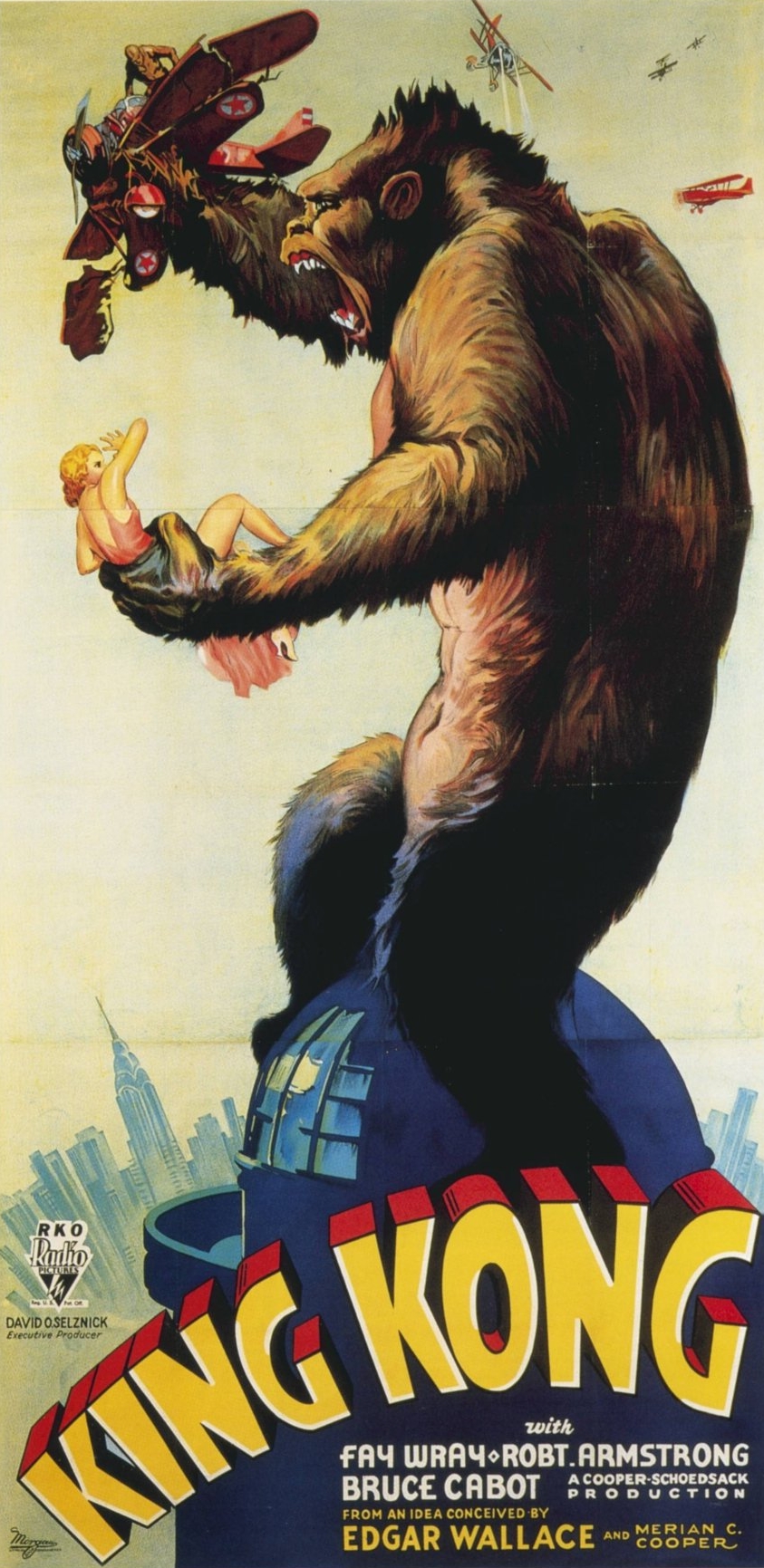
Fig. 1 Poster
Merian C. Cooper and Ernest B. Schoedsack's 'King Kong' (1933) is a very influential film; Willis O'Brien's monsters, the special effects and Fay Wray's screaming are incredibly iconic. O'Brien's work has inspired every monster movie since, such as 'Jurassic Park' (1993), 'Alien' (1979), 'The Lost World' (1992) and 'Cloverfield' (2008). Kong was an excellent feat of creativity and engineering that ensured the film will never be forgotten.

Fig. 2 Kong and Ann
It takes a while to get used to the mechanical movements and strange nature of the Kong model but after a small time the character becomes more believable and the viewer can sink further into the story.  Far fewer people had seen a real gorilla move at the time of the film's release and so it would have been easier for viewers in 1933 to come to believe the special effects. The stop motion monsters in this film will have seemed more real than anything seen in film before, stunning audiences and creating a massive impact in cinema. The brilliant visual effects of the film seem to have been the main focus of the film by a very long way, at the time it was said that 'Neither the story nor the cast gains more than secondary importance, and not even close. Technical aspects are always on top'. (Bigelow, 1933).

Fig. 3 Ann, captured by the natives of Skull Island
'King Kong' is a product of its time, the film has a very insensitive representation of minorities and it objectifies women. The natives of Skull Island are depicted as unintelligent and savage and there are parallels between Kong's capture and slavery, as he is taken from his home world and displayed for the entertainment of white people. Fatimah Tobing Rony writes that 'The Lineage of King Kong should be obvious: the filming, capture, exhibition, photographing, and finally murder of Kong takes its cue from the historic exploitation of native peoples as freakish "ethnographic" specimens by science, cinema and popular culture.' (Rony, 1996:159). In addition, Fay Wray's character Ann Darrow is depicted as frail and silly and the men are often shown insulting her, including the man she falls in love with. This film adhered to and likely helped cement the Hollywood format that continued for a very long time and still lingers: tall, unworthy white man rescues pathetic, dainty white lady from huge black brute - or some other nasty racial stereotype.

Fig. 4 Kong displayed in New York
The film does have fantastic action scenes; the fight between Kong and the dinosaur as Ann sits trapped on a massive tree is very impressive in a variety of ways. The mastery of the models is apparent in this scene and the stop motion animation is masterful, many technical aspects shine in this scene. It also creates a good feeling of suspense, as the viewer is beginning to become attached to Kong,  and Ann sits in a very precarious position as the fight carries on around her. Roger Ebert writes that O'Brien's work in this film had 'a sophistication and beauty that eclipsed anything that went before.' (Ebert, 2002).

Fig. 5 Kong battles a dinosaur

The musical score is also very important, both in its excellence at enhancing the visuals and story of the film and in the effect it had on the future of music in cinema. 'Max Steiner's music adds fantastic atmosphere (it also helped lay down some of the basic rules of motion pictures scoring).' (Haflidason, 2001). Sound in feature film was still a recent development when 'King Kong' was made, so there was room for exploration. Though Max Steiner took influence from Richard Wagner in his method of assigning a theme for each character, the musical score for Kong was revolutionary in cinema and it has massively influenced the film industry. The music was described as 'gripping and fitting' (Bigelow, 1933) at that still holds true today.

Bibliography

Bigelow, J. (1933) Review: King Kong. At: http://variety.com/1933/film/reviews/king-kong-2-1200410783/ (Accessed on 08.10.16)

Ebert, R. (2002) Great Movie King Kong. At: http://www.rogerebert.com/reviews/great-movie-king-kong-1933 (Accessed on 08.10.16)

Haflidason, A. (2001). King Kong (1933) At: http://www.bbc.co.uk/films/2001/01/30/king_kong_1933_review.shtml (Accessed on 08.10.16)

Rony, F. (1996) The Third Eye: Race, Cinema, and Ethnographic Spectacle. [Online] At: https://books.google.co.uk/books?id=ZFZTUSikmFkC&printsec=frontcover&dq=The+Third+Eye:+Race,+Cinema,+and+Ethnographic+Spectacle&hl=en&sa=X&ved=0ahUKEwiAoufD4MvPAhVE1xoKHdBxCSEQ6AEIHDAA#v=onepage&q&f=false (Accessed on 08.10.16)

Illustrations

Fig. 1 Poster
Cooper, M and Schoedsack, E. (1933). 'King Kong'. [Poster] At: https://upload.wikimedia.org/wikipedia/commons/f/f3/Kingkongposter.jpg (Accessed on 08.10.16)

Fig. 2 Kong and Ann
Cooper, M and Schoedsack, E. (1933). 'King Kong'. [Film Still] At: http://www.shillpages.com/faywray/wrayfp35.jpg (Accessed on 08.10.16)

Fig. 3 Ann captured by the natives of Skull Island
Cooper, M and Schoedsack, E. (1933). 'King Kong'. [Film Still] At: https://images-na.ssl-images-amazon.com/images/M/MV5BMTc1MzU1MzQxM15BMl5BanBnXkFtZTgwMTYzMzU5MTE@._V1_.jpg (Accessed on 08.10.16)

Fig. 4 Kong displayed in New York
Cooper, M and Schoedsack, E. (1933). 'King Kong'. [Film Still] At: http://manapop.com/wp-content/uploads/2015/07/kong-on-stage.jpg (Accessed on 08.10.16)

Fig. 5 Kong battles a dinosaur
Cooper, M and Schoedsack, E. (1933). 'King Kong'. [Film Still] At: http://room226.weebly.com/uploads/5/3/4/4/5344580/6639772_orig.jpg?317 (Accessed on 08.10.16)


7 October 2016

Illustrator Monster: Fantastic


Now in colour! I have named her Fantastic.
She's quite tired from staying up late reading lots of books, so she has some quite large dark shadows under her eyes.

I'm still getting to grips with the pen tool in Illustrator. I struggled with a few of shapes for the under eye shadows, but I'll continue to practice.

Animation and Character: Lesson 3 - Bouncing Ball Animation

A bouncing ball

Bowling ball, ping pong ball and tennis ball

I really enjoyed this exercise, I made some errors that I had to fix but it was a good learning experience and I'm pleased with the result.