Showing posts with label Animator Reviews. Show all posts

28 October 2016

Richard Williams

Animator Richard Williams was born in Canada in 1933, and attended art school. His book 'The Animator's Survival Kit' (2001) is an important text often described as essential reading for people interested in animation.

Fig. 1 Richard Williams
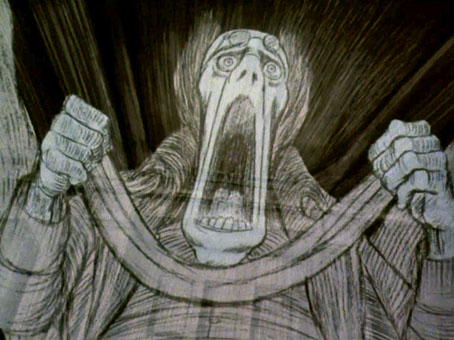
Some of the most famous film's Williams worked on include his roles as animation director for 'Who Framed Roger Rabbit?' (1988) and director and animator for 'A Christmas Carol' (1971). He provided the opening sequences to the 'Pink Panther' movies and also worked on the television film 'Ziggy's Gift' (1982), which won an Emmy award.

Fig. 2 'A Christmas Carol' (1971)

Williams is often seen as one of the best examples of classic hand drawn animation and his approach, as outlined in 'The Animator's Survival Kit' (2001), continues to be relevant, not only for traditional animation, but for all fields of animation. He has won 3 Oscars, 2 British Academy Awards and another 250 other awards.

Bibliography

Illustration List

Fig. 1

Fig. 2 

Bill Plympton

Bill Blympton was born in Portland, Oregon in 1946, where he learnt to draw and his imagination grew. He studied at Portland State University and, as a member of the film society there he made is first attempt at animation. He has done a lot of design and illustration work but animation has always been an obsession of his. 
Fig. 1 A Self Portrait of Plympton
Plympton describes himself as 'really terrible at writing dialogue' (Plympton, 2015), he also believes that 'it's more poetic to tell a story through visuals and music, the head gestures, the eyes, the hands, the things like that.' (Plypmton, 2015). For these reasons his films are often free of dialogue. 

Fig. 2 The Tune
Plympton did a lot of commercial work and some very well received short films before building up to a full length animated film 'The Tune' (1992). Plympton hand draws all of his animations and this film took 30,000 cels to create. He has received several life time achievement awards from different organisations including SITGES Film Festival and Action on Film International Film Festival. 

Lotte Reiniger

Lotte Reiniger was a German animator, born in Berlin in 1899. Reiniger made more than 60 films in her life, beginning to experiment while still in school. Reiniger's masterpiece, 'The Adventures of Prince Achmed' (1926), is considered to be the oldest surviving feature length animation and took 3 years to complete. She was inspired by Chinese shadow puppetry and she created delicate paper silhouettes for her animations.

Fig. 1 'The Adventures of Prince Achmed' (1926)
Her animation was revolutionary and there is no doubt that she has inspired works throughout history and her influence can still be felt today. Film historian and reviewer Philip Kemp wrote for Screen Online that 'To date she has no rivals, and for all practical purposes the history of silhouette animation begins and ends with Reiniger.' (Kemp, s.d.)

Fig. 2 Reiniger at work
She based the stories for her animations on European fairy tales and tales of the Arabian Nights; this combined with the Chinese influence on her style makes for a very interesting and unique atmosphere to her works. Sarah Cronin, writing for Electric Sheep Magazine, commented that Reiniger worked by 'depicting her characters with an almost grotesque exaggeration that mirrors the over-the-top acting in live action silent pictures.' (Cronin, 2008) Reiniger's work can be related to the German Expressionist movement; the dark silhouettes, crooked shapes and exaggeration in her work are reminiscent of the style in films such as Robert Weine's 'The Cabinet of Dr Caligari' (1920). She also created stunning worlds for her characters to inhabit and was able to create a sense of depth that thoroughly defies the inherent flatness of the paper she worked with.

Fig. 3 'Sleeping Beauty' (1954)
Bibliography

Boult, A. (2016). 'Who is Lotte Reiniger? The pioneering animator who would have been 117 today'. At: http://www.telegraph.co.uk/technology/2016/06/01/lotte-reiniger-the-pioneering-film-maker-whose-shadow-puppets-in/ (Accessed on 28.10.16)

Cronin, S. (2008). 'Lotte Reiniger's Fairy Tale Films'. At: http://www.electricsheepmagazine.co.uk/reviews/2008/12/02/lotte-reinigers-fairy-tale-films/ (Accessed on 28.10.16)

Kemp, P. (s.d.). 'Reiniger, Lotte (1899-1981)'. At: http://www.screenonline.org.uk/people/id/528134/ (Accessed on 28.10.16)

Nye, S. (2013). 'SCOTT REVIEWS LOTTE REINIGER’S THE ADVENTURES OF PRINCE ACHMED [BLU-RAY REVIEW]'. At: http://criterioncast.com/reviews/blu-ray-reviews/scott-reviews-lotte-reinigers-the-adventures-of-prince-achmed-blu-ray-review (Accessed on 28.10.16)

Illustration List

Fig. 1 'The Adventures of Prince Achmed' (1926)

Fig. 2 Reiniger at work

Fig. 3 'Sleeping Beauty' (1954)

13 October 2016

Don Hertzfeldt

Don Hertzfeldt is an animator who has been making animated films for over twenty years. He studied film at the University of California, Santa Barbara, where he had access to their animation camera. Prior to this he had also used a VHS camera to teach himself some basics. (Robinson, 2010:179) 

Fig. 1 'Billy's Balloon' (1998)
'Billy's Balloon' (1998), one of Hertzfeldt's earliest films, is funny and somewhat horrifying. The film depicts a balloon assaulting a small child, twisted and yet it still manages to charm. Chris Robinson describes the violence as 'so utterly absurd that can't help but laugh'. (Robinson, 2010:182) There seems to be no point to the story, but the film is still engaging and this is reminiscent of the surrealist movement, in the sense of making strange art that has no obvious meaning.

Hertzfeldt is also known for his ability to create emotional films using much simpler methods than one might think necessary. His animation uses simple stick figures and has been largely traditionally hand drawn, with only more recent use of digital tools. David Jenkins of The Guardian writes: 'Hertzfeldt's method of making grand existential statements with almost recklessly modest means has made his cinematic oeuvre one of the most fascinating and enjoyable of all contemporary American directors.' (Jenkins, 2013).

Fig. 2 'World of Tomorrow' (2015)
Hertzfeldt's most recent film, 'World of Tomorrow' (2015), is quite grand in the way it explores the future of humanity. David Sims of The Atlantic comments that it 'poses fascinating questions about our commitment to living as long as we can by whatever means we can devise.' (Sims, 2016). This is Hertzfeldt's first science fiction film but it is his favourite genre and he got some ideas for the look of the film from the covers of old sci-fi books. (Bramesco, 2015).

Bibliography


Robinson, C. (2010). Animators Unearthed: A Guide to the Best of Contemporary Animation. [Online] At: https://books.google.co.uk/books?id=oozKz8Hu4xIC&pg=PA179&dq=don+hertzfeldt&hl=en&sa=X&redir_esc=y#v=onepage&q&f=false (Accessed on 13.10.16)

Bramesco, C. (2015). Animator Don Hertzfeldt on not trusting happy people. At: https://thedissolve.com/features/interview/980-animator-don-hertzfeldt-on-not-trusting-happy-peop/ (Accessed on 13.10.16)
Jenkins, D. (2013). Don Hertzfeldt: the best animator you've never heard of. At: https://www.theguardian.com/film/filmblog/2013/may/02/don-hertzfeldt-animator-beautiful-day (Accessed on 13.10.16)

Illustration List

Fig. 1 'Billy's Balloon' (1998)
Hertzfeldt, D. (1998). Billy's Balloon. [Film Still] At: https://i.ytimg.com/vi/7jksRQcI9NA/maxresdefault.jpg (Accessed on 13.10.16)

Fig. 2 'World of Tomorrow' (2015)
Hertzfeldt, D. (2015). World of Tomorrow. [Film Still] At: https://i.vimeocdn.com/video/555705466_1280x720.jpg (Accessed on 13.10.16)